Showing posts with label 35mm. Show all posts

Saturday, November 21, 2015

Published 8:59 AM by with 2 comments

Erie Street - Americana in Bisbee, Arizona


I was born in Dublin in the sixties and spent the first twenty two years of my life there. It was a relatively simple world when I was a kid and we only had a couple of TV channels where I lived. Every Saturday afternoon, on the BBC, there would be an American movie playing that kept me glued to the screen. I found myself particularly drawn to stories of the Bogart and Hitchcock era, set in small-town America. Everything about them fired my imagination.
Americana, that optimistic era of the forties and fifties, full of ingenuity, has cast a spell on me ever since. Through my eyes it was a time when cars and architecture were more like works of art than mere machines and structures of utility.
The reality, of course, is that it probably wasn't quite as glamorous as nostalgia and Hollywood would suggest. Nonetheless, it left a beautiful legacy that can occasionally be seen off the highway, in small tucked-away towns.
One of those places is Bisbee in Arizona. It has a rich and colorful mining history and resembles a European town entwined in steep hills and narrow, winding roads. As fascinating as it is, I was much more attracted to one of its lesser-known attractions in the nearby community of Lowell.
Just down the road from the massive open pit of Queen Mine sits a '55 Ford station wagon. Parked in a vintage Shell gas station, completely devoid of people, it feels like stepping into an episode of the Twilight Zone. This was my first introduction to what is known as the Lowell Americana Project.

The project is the brainchild of Jay Allen, one of a handful of people who live on the curious and otherworldly Erie Street. Its mission is to showcase and preserve a time in the forties and fifties when the area thrived. Long term plans include rebuilding and repainting all the existing storefronts. They will then be populated with authentic merchandise to create an immersive time travel experience for visitors. Don't bring your credit card, though, the interiors will be for display purposes only.

Restoration has already begun and the Shell gas station and police station/jail have gotten recent makeovers. Other buildings, like the garage, are actually functional, although the pumps are only for show.


Each year, Lowell hosts a music festival that includes a car show and work from local artists. The funds raised go towards advancing the goals of the Lowell Americana Project. For more information on the event, click here.


Down Memory Lane
An old taxicab waits for a passenger as the sun rises over Erie Street.

Preserving Authenticity
Vintage cars, coupled with restored facades, create the quintessential atmosphere of Americana.

The Automobile as Art
In our modern world of generic cars, the designs of the past, especially these magnificent fins, are thrilling to see.

Realizing a Dream
Jay Allen's vision slowly takes shape. The "new" Lowell police station and jail breathes life into the old street.

Great care has been taken to maintain the integrity of Lowell's past. Signs are hand-painted to replicate the styles of the time.


While peering through the window of the dilapidated Sprouse Reitz store, I noticed some old broken mannequins stacked up. There was something almost human about them, like they were sadly staring out at the real world. Even the expressions and gestures felt a little unsettling to me.


What's most striking about this street is the sheer detail of everything in it. Posters look and feel authentic and I had a great appreciation for the character of each door and window frame. Even the gas pumps looked like something out of a science fiction novel. During the few days I spent there, I couldn't help feeling that this kind of workmanship is just not that prevalent anymore.

I've been to many auto shows in my life and seen all sorts of vintage cars but walking down Erie Street is an entirely different experience. For me, it's all about context. If you listen hard enough, you can almost hear the voices and footsteps of those who once shopped for bargains, lined up for the matinee or treated themselves to a milkshake.

Erie Street transcends its relatively small footprint. Although it's just over seven hundred feet in length, it's easy to imagine the scope of what it once was. With the efforts of people like Jay Allen and countless other volunteers, perhaps it truly can be resurrected to remind us of a time in our culture when life was simpler and full of optimism.

My Adobe Spark (formerly Slate) presentation of this post is available here

If you would like to keep up with my travels, sign up to be notified of new posts. Peace.
Read More
      edit

Wednesday, October 14, 2015

Published 8:08 AM by with 0 comment

Desert Oasis - Traversing California's Dusty Roads


Linda and I spent a month in Santee, California to see our daughter Tara. We didn't expect the sustained heat wave that had temperatures in the triple digits so we planned a few day trips to escape the inferno.
We decided to scout out some nearby locations in the desert that were on our upcoming travel agenda. Of course, going to the desert wasn't exactly going to help us escape the heat but that's what air conditioning in our car is for, right?
I have to admit that, on the outset, the idea of staying in a dry and dusty environment for any length of time was not something I was excited about. I have since discovered, however, that quite the opposite is true and that there is something wildly intoxicating about the desert.


It's hard to articulate my newfound attraction so I went in search of a way to explain the experience. First stop: Google. Almost immediately, I found the following quote by the founder of Desert Magazine, Randall Henderson. He sums up my own feelings beautifully:
"'For there are two deserts: One is a grim desolate wasteland. It is the home of venomous reptiles and stinging insects, of vicious thorn-covered plants and trees and unbearable heat ... visualized by those with children of luxury to whom any environment is intolerable which does not provide all the comforts and luxuries of a pampering civilization. ... The other desert -- the real desert -- is not for the eyes of the superficial observer or the fearful soul of the cynic. It is a land which reveals its true character only to those who come with courage, tolerance, and understanding. For those the desert holds rare gifts".
While I'm not sure about the courage part for myself, I certainly believe that there is beauty to be found everywhere, even if it first appears as all scrubs and sand. With open eyes and an open mind, the experience can be a rich one. Although we have only spent limited time there so far, I'm looking forward to immersing myself further in this new world.

Borrego Springs
The drive down into the flat plains of Anza-Borrego State Park is breathtaking. State Highway S22, better known as the Montezuma Grade, winds its way down in dramatic fashion with views of the surrounding Santa Rosa mountains, the sprawling desert floor and the Salton Sea on the horizon.

Borrego Springs itself is a small town, sprinkled with restaurants and RV parks. We actually spent most of our time a few miles east of town, checking out the Rockhouse Trail area where we intend to boondock (RV camping at primitive sites without electricity or water). At the end of this first day, I was smitten with the place.


Palm Springs
Palm Springs is one of a series of desert towns that run into each other in the Coachella Valley. It's most famous as a destination in the fifties and sixties for such celebrities as Humphrey Bogart, Lauren Bacall, Clarke Gable, the list goes on. Frank Sinatra and the Rat Pack were known to sing a tune or two while having a nightcap or six. Even Elvis got in on the action by spending his honeymoon there with Priscilla.
What drew me in mostly, however, was the other thing Palm Springs is famous for; it's mid-century modern architectural homes. For as long as I can remember, I've been a fan of all things 1950s. I love the fashion, the interior design and the genius architects of the time. I was thrilled when Mad Men first began to air because I could immerse myself in that world for an hour every week.
Mid-century modern architecture, while largely associated with mingling by the pool with martini in hand is, to me, a classic example of timeless design. The simplicity of lines, the flat washes of bold color and the scant but geometrically-perfect front yard schemes, all conspire to form a kind of perfection in my eyes.
For me, as a photographer, it was a rare treat. It was like walking around a movie set. The backdrop of mountains and palms was exotic as were the streets lined with these gorgeous houses.

Palm Springs Modernism
Mid-century modernism features clean lines, integrated indoor/outdoor living spaces and an overall simplicity in its aesthetic.


Bold Light and Shady Trees
The desert sun accentuates the architectural lines of the abundant mid-century residences. Some of these houses, when first built, came with landscape features, including a set of two palm trees. This particular neighborhood is aptly named Twin Palms.


Elephant Feet
All around are mountain views and huge palm trees with lofty bases reminiscent of the limbs of giant elephants.


The Slabs and East Jesus
If you're familiar with the world of Mad Max (sans the violence), then you can begin to imagine the experience of being at Slab City, or the Slabs, as it is known.
Deriving its name from the concrete slabs that remain from an abandoned World War II barracks, Slab City sits in the Sonoran Desert about 150 miles northeast of San Diego. It is a winter haven for campers, artists and those searching for meaning in their lives. You won't find running water, electrical services or convenience stores here.
The "residents" who live here during the non-summer months have concocted ingenious ways to exist off the grid. From composting toilets to eking power out of discarded and/or damaged solar panels and batteries, they have constructed a self-sustaining environment that runs against the odds. Given that it was only a couple of hours drive from Santee, it was a no-brainier for us to go visit.
Our first stop was Salvation Mountain, a man-made concrete mound about three stories high and covered top to bottom in acrylic paint. It was the brainchild of one Leonard Knight, former resident and larger-than-life character who would meet and greet the many daily visitors and even give personalized tours to a lucky few. Alas, he passed away in 2014 but his legacy is plain to see. Tourists are encouraged to add their own artwork and paint cans and brushes are provided for those feeling a creative urge.


We drove into the Slabs and gawked at some of the blinged-out RVs, cars and trucks. Each space was carved out with artistic flair, some more creative than others. One site was tidy, while the other looked more like a junkyard. There was an otherworldliness to the entire place. We zig-zagged our way until we reached East Jesus, the central hub of artistic expression.
Frankly, it was a little intimidating walking around and, although photography is allowed and actually welcomed, I couldn't help but feel a little like a voyeur on some stranger's property. There were fascinating objects everywhere, from a half-buried bus to items of decay refashioned as sculpture. There was even a human skull on display, complete with fake eyeballs.


While in the sculpture garden, I was welcomed by Frank. He lives in East Jesus and gives tours to visitors. I wasn't expecting to see anyone because it was upwards of a hundred degrees while we were there. Frank was a towering figure and friendly, if not a little manic. His sense of humor was somewhat jarring at first. After he gave me his initial schpiel, I asked if he lived here. "No, of course not, I'm just some fucking random guy who's here masquerading as a tour guide!", he replied. It was delivered with a Joker-like smile so I nervously laughed it off. He then left me among the sculptures saying I was free to photograph whatever I wanted.


Walking around the garden and seeing everything we typically throw away made me think about how much each of us consumes over time. It's amazing the things we take for granted, like never worrying about where our trash goes once it's collected. Anyway, enough trash talking, back to the story.
Frank appeared again shortly after my initial encounter. He materialized, it seemed, out of nowhere. If there was a soundtrack in my life, this is where the jump scare orchestral stab would occur.
Photographers, it seems, are held in high esteem here at East Jesus and maybe Frank even took a liking to me. He invited me behind the scenes for a private tour of some of the living quarters. I felt like Dorothy meeting the Wizard.

"Walter the Bus" had a recent mural makeover courtesy of artist Christina Angelina.

Frank spoke at a frenzied pace now and wouldn't allow questions. He laughed maniacally when I tried to speak and said "Look, this tour is a performance, don't interrupt. I guarantee your questions have been asked a thousand times and they will be answered all in good time". I'm not going to lie, there was something intimidating about Frank. Not threatening in any way, but I didn't want to distract him while he spoke for fear of getting him off his game.
In the meantime, Linda was sitting in the car waiting for me. The last she heard, I was taking a few photos in the sculpture garden and would be right back. That was twenty minutes ago! I managed to shoot her a text while Frank wasn't looking. "On a tour!" I quickly typed. I felt relieved that she at least knew I wasn't dead or kidnapped or attacked by scorpions.


The tour wound up and I was finally able to make my escape. Had I been there alone, I probably would have stayed to get some more photographs but with the high temperatures, I wanted to get back to Linda and move on. We'll be back in the area in at some point so I didn't feel like I was relinquishing a once-in-a-lifetime opportunity.
Honestly, the whole experience was unique, in the true sense of the word. I think that everyone who comes here will walk away with a different perception of the place. There is an associated Website for East Jesus and it's fascinating to read the mission statement. If you're interested, click on this link.

So, while Randall Henderson says there are two types of desert, I would add to that and say there is also an infinite number of experiences to be had. Being there, for me, was infectious. It has already gotten under my skin and I am counting the days until we return.
My Adobe Spark (formerly Slate) presentation of this post is available here
If you would like to keep up with my travels, sign up to be notified of new posts. Peace.
Read More
      edit

Wednesday, September 30, 2015

Published 7:50 AM by with 0 comment

As Time Goes By - Finding the Photographer Within


Photography, for me at least, has been a solitary endeavor and I like it that way. When I grab my camera and drive to some new (or familiar) location, part of the excitement is not knowing what I will create and not having to worry about anything or anyone. I like to let what's in front of me slowly unfold until it eventually reveals itself.
Some will argue that taking a photograph is simply extracting part of a scene that already exists so there's no real interpretation involved on the part of the photographer. I don't subscribe to this notion.
The famed photographer Henri Cartier-Bresson once said "Your first 10,000 photographs are your worst." I think that's true but it took me a long time to truly understand what he meant.
When I started capturing still images, I wanted to be an accomplished photographer right away and...I was...in my own mind. What I've realized since then is that my ability to assess my own progress has shifted at the same rate as my accumulated experience. When I first began capturing images, I had no real sense of what I wanted to do. My time shooting up to that point was quite limited and I had learned very little. In my naïveté, I thought my photographs were really something special. When I look back on that work now, with over ten years of experience under my belt, my photographs seem positively amateurish.
I believe in the old adage that says "there is no substitute for experience". When I bought my first serious camera, I read every single photography book I could find. While they all helped me to understand and operate my camera, none really taught me how to be a photographer. There were many volumes that discussed the philosophy of capturing an image but it didn't mean anything until I actually began shooting and, over time, discovered my own vision.
Then one day everything began to make sense. I understood that I was no longer a simple practitioner of the medium, in fact the camera itself was now just a means to an end. Photography, I realized, started with an urge to create. It was no longer important for me to capture a technically perfect image, although I understood the theory of how to do that. What was important was knowing how to capture the essence of my response to a place, person or thing and present those thoughts and emotions in a two dimensional picture.
One of the highest compliments I have ever received from someone was when he told me that I helped him see the extraordinary in the ordinary. Suddenly, he was able to see a beauty in his daily life that had previously eluded him. Wow.
So what am I trying to say here? I think there are two types of photography. One is where the scene is captured as faithfully as possible and the camera does most of the work. The other has the photographer, as faithfully as possible, capturing his or her vision in a coherent image.
A tall order? Yes, but there are countless photographers out there who have tapped into this realm. Ansel Adams did it in his landscape work. SebastiƤo Salgado does it in his epic portrait and environmental images. Richard Avedon transcended portraiture and fashion to an art form. These are just a few examples but the list goes on.
There are times when I feel like I have found a portal into this world. I feel it when i hold my camera and look through the viewfinder. What I see is constantly a wonder to me and my excitement is almost always brimming over the edge. I think it's that reverence for image making that keeps my passion alive.
In the meantime, I know that when ten more years have passed, I will look back on my present work and feel the evolution of my thoughts and ideas. I'm curious to know what my future self will make of the person presently sitting in this chair. Only time will tell.
My initial idea for this blog post was to write about my recent visit to Balboa Park in San Diego but I obviously went off on a serious tangent. That being said, I'll mention it briefly now.
When I first arrived at the park it was to meet up with a group of photographers for the global 500px/Fujifilm Photowalk. Sadly, I mixed up the actual meeting place and missed the event. I was with my daughter Tara so we decided to do our own walk instead. No point in squandering an opportunity to shoot such a beautiful venue.


Balboa Park is all about light and depth

Who could resist shooting this very cool sculpture?

This sign and the texture of the wall reminded me of an old Charlton Heston-style movie.

I don't shoot many candid moments but I liked this man's stance and his big hat.

Something about the shadow of the stair rail in the background caught my eye.

The silhouette of the rail and the textures drew me in to this composition.


A Lost World
Walking around the wonderful grounds of Balboa Park makes me feel like I am exploring another planet. It's hard to believe downtown San Diego is just a mile away going about its business.


Exotic Land
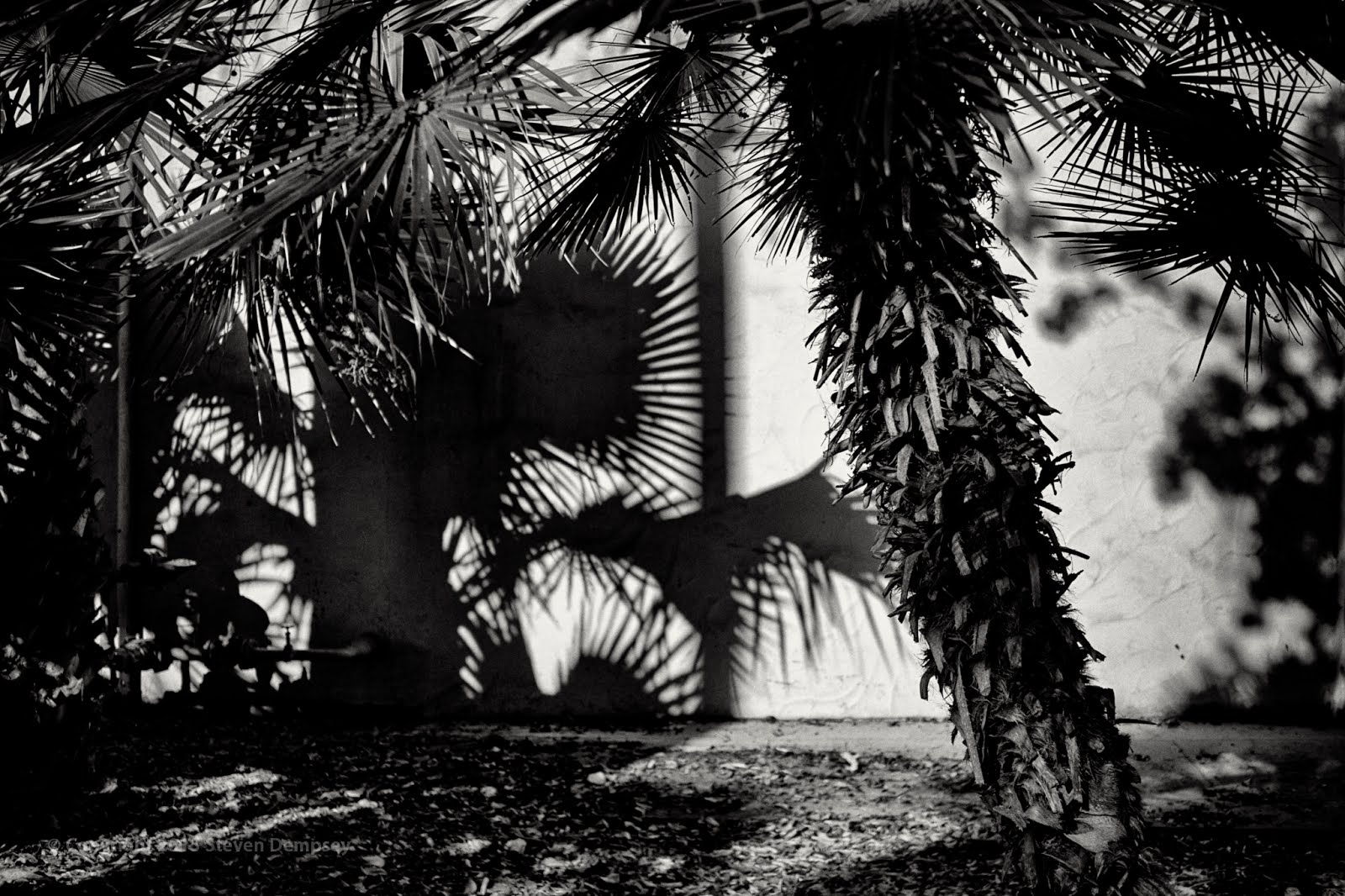
Not exactly exotic to those who live here but, to me, these trees represent something unfamiliar. This is especially so given my previous abodes in Ireland, New York and Seattle. It is fascinating to me that these long skinny trunks don't just keel over.


I think this door is really interesting for reasons I can't describe. 

Shooting places and things is one thing but once a person is inserted into the mix, the entire meaning is transformed. Tara is really photogenic and is very comfortable in front of the camera. Her dress and hat gave her a classic look that worked well with black and white. The resulting shots made me think of a spread in Vogue Magazine from the fifties.


Tara contrasts dramatically with the light and architecture.

This young child unexpectedly bolted across the frame just as I pressed the shutter.

My Adobe Spark (formerly Slate) presentation of this post is available here

If you would like to keep up with my travels, sign up to be notified of new posts. Peace.
Read More
      edit