Showing posts with label sand. Show all posts

Thursday, September 11, 2014

Published 8:14 AM by with 2 comments

Beachcombing

Who doesn't love the beach? It represents so many varied things to an equal number of people. It brings joy to children and adults alike. I love the beach but not in the sense of it being a resort. I'm drawn to areas where people are a rare sighting. I love being alone by the ocean and I've had a lot of opportunities recently to do just that. Once Labor Day is over here in the States, it basically signals the end of weekend jaunts by the masses to these coastal jewels.

When I'm walking alone on the sandy shores, I think about the vastness of nature and my own insignificance. It's actually comforting to know that I am less than a speck on the face of a giant clock that represents Earth's history. I can see the way both water and sand have shaped the things around me. Rocks smoothed down to glassy forms that will continue until they themselves become grains of sand. Huge tree trunks once floating on the ocean and now dried out and resembling skeletons on the beach. Remnants of sea life; empty crabshells, the glistening snake-like forms of seaweed, the twinkling light reflecting off both tiny and huge jellyfish.

Cape Blanco Beach on the most Westerly point of the United States has such strong winds that the beach literally changes in front of your eyes. The footprints I made while walking on the soft sand disappeared as quickly as they were formed. The strong gusts of wind send millions of grains of sand slithering across the surface like so many snakes.

It was both exhilarating and terrifying to be leaning into the gusts trying to find photographs amongst the debris of the beach. Exhilarating because there is no end to what you can discover every few feet but terrifying because the swirling sand might get into my camera and lens. There were a few times where I just whipped out my iPhone and used it instead. I kept my big camera under my shirt until I was absolutely sure of the shot I wanted. Miraculously, my camera and lens were unharmed but I'll be more cautious in the future about risking damage to my equipment (no you won't, Steven).


I love the idea of a lone figure against a dramatic landscape. Linda and I were walking along Battle Rock Beach in Port Orford, Oregon and it provided the perfect backdrop for her silhouette. As I have discussed before, having something familiar in a photograph gives the viewer a sense of the scale of its context. The light was at a perfect angle to separate all the elements into layers of depth.


This was a challenging shot because there was so much contrast. The small amount of detail behind Linda was important to convey the sea and I had to work hard in post production to bring out the detail in the sand and the rock. It almost feels like the rock is a living thing, like the textures suggest it is a dinosaur.


Reflections can be a cliche and maybe this photograph is one but I liked the way it is not a perfect mirror-like reflection. The ripples caused by the wind give it some texture and separate it from the actual rocks.


I had about 2 seconds to get this shot as we were leaving the beach. The setting sun was directly behind this couple and there was a moment where I could feel they were experiencing something special together. My exposure was not correct but I pointed the camera and spun the shutter speed wheel until I saw the correct settings and took the shot. I would never be able to get a precise exposure using any kind of auto setting on the camera so it was good to know what I was doing just then. This is definitely one of those "decisive moments".


In my last blog, I mentioned that I didn't have the light I wanted while I was visiting the sand dunes of Florence but I had better luck at Cape Blanco. I love the way the low angle of the sun accentuated the ripples. Nature is constantly fascinating to me.


Another cliche shot but sometimes you just have to shoot stuff for yourself. If I was to avoid every cliche, I probably wouldn't have any photos to show. Sometimes these kinds of shots can lead to more interesting creative opportunities. Again, the low angle of the sun made this a fun photo.


There was lots of dried out wood on Cape Blanco Beach and many resembled skeletons. This one reminded me of a skull from some prehistoric animal, complete with eye sockets. The sand drifts around it made it beautiful to me.


More evidence of the strong winds on the Oregon Coast. I like the meandering leading lines in the shot.


This is another dried wood form that reminded me of perhaps a prehistoric fish. The arched shape and sand drifts leading off to the horizon gave it a feeling of loneliness. I almost felt sorry for this abandoned fish-like creature.


This is a closer shot of the same fish creature that is really dead wood, of course, but seeing these things on the beach makes my imagination run wild.

At some point soon, we will be leaving the coast for desert terrains in Arizona, New Mexico and Texas so I wanted to get as much shooting done at the beach as I could. Things shift so much in this wild landscape that it will be a whole new experience the next time I visit.
Read More
      edit

Wednesday, August 27, 2014

Published 7:10 PM by with 1 comment

Increasing the Odds of Serendipity

Sometimes people look at my photographs and say I was lucky to be there at that particular moment with that particular light. Maybe they are right.

I don't think that luck happens randomly. I tend to be out shooting quite a lot. I have studied weather and wildlife for many years so I can usually make an educated guess ahead of time what kinds of photographs I am going to shoot. Great moments happen every minute of every day but we are just not always present to them. Sometimes, because we are out there exploring our world, we are. 

Case in point: Linda and I were staying in Kelso, WA. We decided to drive to Seaside in Oregon for the day but when we got there, the fog was really thick. I am usually drawn to fog but this was just a flat soupy mess. We decided to continue on the seven miles to Cannon Beach, one of our favorite spots in the Northwest.

As The monolith known as Haystack made itself known when we came around a bend on Highway 101, I knew it was going to be a good day. A thick marine layer was on the beach and the giant rock's tip was peaking ominously out from the top. The sun tried to penetrate the misty air but with little success.

It was hard for me to resist shooting every few seconds. The fading silhouettes of beach walkers made the entire place feel mysterious. The stark contrast between the people and the foggy backdrop with faint outlines of the rocks made for perfect black and white fodder.


A family was sitting under this umbrella, taking photos of Haystack monolith. The sunlight made them stand out in an almost three dimensional way while the huge mass eerily loomed above.


A single form on the beach looks like he is about to be consumed by the marine fog. These conditions on the beach made it feel like people were in isolation, detached from their counterparts. In reality, the beach was teaming with couples, kids, dogs and more.


The low angle of the sun made the sand ripples stand out in relief. The distant people added a sense of scale and depth in the photograph.


There was a pretty impressive wind but it didn't manage to disperse the dense fog. I liked the contrasting silhouettes of the dragon and the kite flyer.


Before I left the beach, I wanted a shot of either a bucket and spade or a sandcastle. Something I could relate to from my childhood. I settled on this somewhat simple construction. I don't think my own sandcastles were any more elaborate.

As I was about to leave the beach, I turned around and saw all of these people. All are doing their own thing but are unified by their silhouettes. I like the way they are reduced to two-dimensional shapes. It adds a layer of anonymity which, in turn, creates that timelessness I yearn for. It reminded me of a scene from the movie Close Encounters of the Third Kind where volunteers walked towards the intensely lit mothership at the base of Devil's Tower.


Neighboring resort town Seaside provided me with some interesting textures that translate very well into black and white. You really can't go wrong with strong light and weathered wood.

The more I am out there, the more likely it is that I will capture some of the iconic moments that are omnipresent in our world. So, yeah, I am lucky.
Read More
      edit

Tuesday, August 26, 2014

Published 7:47 AM by with 2 comments

From Where I Stand

Ansel Adams once wrote, "a good photograph is knowing where to stand" and it made me think about how true that is for me. I'm not usually conscious of the amount of effort I expend composing a photograph but I know it's substantial. Well, it certainly is now that I have slowed down and am really trying to make photographs rather than take them.

Having a zoom lens can sometimes make me a lazy photographer. What I mean is, if I have a lens that has a focal length of, say, 24mm-104mm, that's a pretty wide span and I don't need to move at all from where I stand to get a variety of shots. Each shot I take is just a zoomed in version of the same thing. I sometimes cheat myself out of other potential angles and compositions when I bring a zoom lens along with me.

With a prime lens (one with a fixed focal length or, to put it another way, no zoom capability), I have to physically move to "zoom in". If I want something to be closer, I have to move the camera closer or if I want the subject to be wider, I have to move further away with the camera. Doing this is a good idea for me because it makes for more opportunities to experiment with different compositions. Maybe I want to move to the left or right or maybe up or down. What about on a diagonal? Not everything has to be straight. When I'm already moving around, it feels more natural and I come away with a true variety of shots.

 When I visited the Westport Lighthouse in Washington, I was far more interested in details than the usual wide angle shooting up at the lighthouse kind of thing. That day the only lens I had with me was a 50mm prime. I moved in close for this shot of the interior. If I had shot the lighthouse like one of the many images you see during a Google search, I don't feel like I would have done justice to my own authentic experience of the place. These little detail shots literally bring back details of my experience.


Another detail shot of the handrail leading up to the top of the lighthouse. I'm deathly afraid of heights and, as we ascended I became more and more nervous looking down. This handrail was my savior so its meaning is significant when I think back on being there at that moment.

I often joke with my friends that if you don't come back with dirty knees, you do not have the shot. What I mean is it's important to get away from just looking at things the way we see them in our everyday life. When we look at a child, we look down at them, simply because they are smaller. We look up at things that are taller than us. It's the way we see things every day and it makes for boring and predictable photographs. I sometimes climb ladders so I can be at eye level with that thing up high. Maybe I'll venture higher and actually look down. What about shooting pets, children or flowers? For me, the most rewarding photographs happen when I get down on my knees at their eye level and capture the world on their terms.

On a recent trip to Rialto Beach in Olympic National Park, I saw a group of rocks off in the distance enshrouded with fog. I knew I had to shoot the scene so I told Linda I was on a mission and took off in a hurry. Afraid that the fog would disperse, I zoomed in full on my lens and took shots of the scene as I approached ever closer over uncooperative wet pebbles and feet sinking into soft sand from the approaching tide.


When I arrived at the rocks, I couldn't believe their actual scale. They were not mere rocks, no, they were 60 feet monoliths and it was an awesome sight to behold. Had I been satisfied with my earlier zoomed shots from afar, I would never have fully appreciated the magnitude of the scene. As a result, I walked away from the beach with some spectacular shots. Converting them to black and white, made the place seem like it was something from the movie Planet of the Apes. I did think to look for remnants of the Statue of Liberty...


Rialto Beach is a favorite of mine to shoot because it does have that sense of time standing still or at least time traveling at an almost immeasurable pace. I can't imagine how long it has taken for all of the deadwood to make it to its current resting place. Here I chose to make the vertical tree the main subject of the picture. On the left in the distance you can see the "little" rocks I was trying to reach.


Scale was also a challenge to convey when we visited Hurricane Ridge in Washington. I spent a long time hunting for the perfect composition but, in the end, I settled for capturing the play of light on the mountain ridges rather than the impossible task of translating into two dimensions the massive size of the scene.


I was equally challenged when I visited Mount St. Helens. The sheer mass of the volcano in front of me was daunting. There was no way to capture that kind of grandeur with my relatively modest camera. Instead, I chose to focus on the crags and fissures and valleys created by the 1980 eruption. The colors were too pretty and distracting for this message so I again chose black and white to finely focus on the many and varied textures. Some clouds moved in over the top to add the final touches to my photograph.


Black and white was also my choice for this scene of the valleys, hills and mountains leading up to the towering volcano. I chose to convey distance and scale through tones of gray.


At the Johnston Observatory at Mount St. Helens, I shot Linda in silhouette to give a sense of being there for the viewer. She is instrumental in, again, conveying the scale of the landscape beyond.


I loved the curve of this trail and all the stuff going on around it. Shooting it without context would make it unremarkable but put a person in the scene and all of a sudden it has a focal point and also a context of scale. Linda's hat adds interest to the scene.

The more I learn about photography, the less I know. This is true today more than ever and it is exciting to know that, for every day of my life, there is a new thing to be learned. For this photographer, at least, the reward is in that quest for the thing, not having it.
Read More
      edit

Saturday, August 23, 2014

Published 1:44 PM by with 0 comment

A Day at the Beach

When I was growing up, my family and I would spend two weeks every summer vacationing usually at some kind of beach resort. We camped in tents, rented caravans and stayed at bed and breakfast farm houses over the years. I guess that's where I got my yearning to be near water. Those were peaceful times. I would not trade a walk on the beach in the early morning for anything. In the wee hours alone on the sand, it felt like I owned the place.

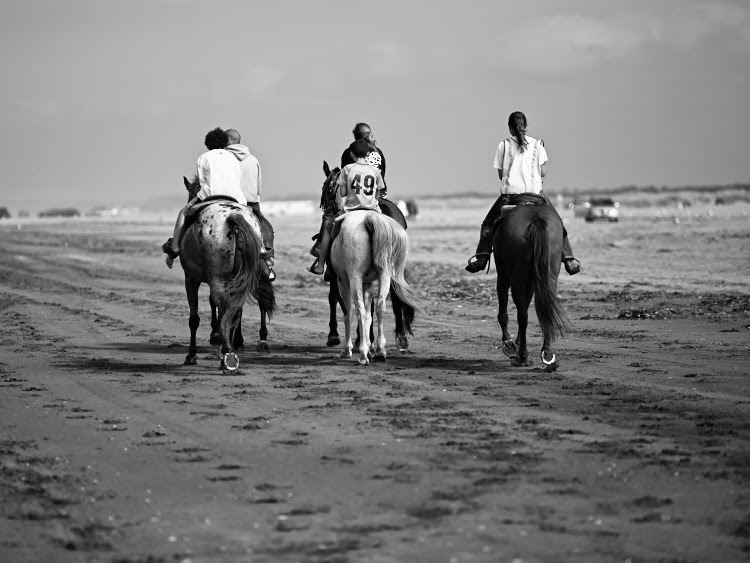
Beaches have always been somewhat solitary for me and it's a good place to clear my head or just regenerate. The rhythm of the tide does that. People go for all kinds of reasons; people-watching, swimming, romancing, tanning, horse-riding, moped-renting...you name it.

But for me, I may as well be back in my childhood again because I can wipe out all of the distractions around me and just focus on the sound of the ocean and feel the breeze on my skin. Being on the road has afforded me more visits to the sea than would be usual in my "former" life. Below are scenes I observed recently from Ocean Shores and Westport Beach in Washington.

This line of horses reminded me of when I was a kid. I think I was on a horse once in my life but it made an impression.

This couple didn't venture too far from their car. Two beach chairs and a great view of the water and passersby

Loved the line of horses. They went for miles until they disappeared into the horizon

Lovers hand-in-hand and children playing. This shot encapsulates so many things I love about the beach

Even though they are a couple, these people seemed a little lonely, like the landscape

What I have learned so far: Slowing things down has enabled me to experience and appreciate the scenes I am shooting. Often, in my not-so-distant past, the moment was lived only through my viewfinder.

Read More
      edit